BEDTIME
My toddler is scared of the dark — what actually helps
The fear is real and it is developmentally normal. The problem is not the fear itself — it is how it disrupts the routine. Here is what actually helps.
In this article
It starts without warning.
A child who has been settling well for months suddenly refuses to let you leave the room. They want the light on. They want the door wide open. They say there are monsters. They cry the moment you reach the threshold.
You haven't done anything differently. But everything at bedtime has changed.
This is fear of the dark — and it appears in most children at some point between ages 2.5 and 4, driven by a specific developmental shift that has nothing to do with anything you have or haven't done.
The fear is real. It is not manipulation. It is not a phase you can reason away. And the response — if you get it wrong — can create sleep problems that outlast the fear itself by months.
Here is what is happening and what actually helps.
Why fear of the dark appears at this age
Fear of the dark is not random. It is a predictable consequence of a specific stage of brain development: the emergence of imagination and symbolic thinking.
Before 2.5, most children do not have the cognitive capacity to imagine what might be in the dark. Darkness is simply the absence of light — neutral, not threatening.
Between 2.5 and 4, the brain develops the ability to imagine things that are not present — to picture the dragon from the bedtime story existing in the shadows of the bedroom, to understand that something could be under the bed even if you cannot see it.
This is the same developmental leap that produces pretend play, storytelling, and imaginative creativity. The fear of the dark is the shadow side of the imagination arriving.
It is not irrational for the child. It is completely rational given their cognitive stage. They genuinely cannot yet fully distinguish between what their imagination tells them and what is actually there.
Fear of the dark is not a sleep problem. It is an imagination problem that happens to occur at bedtime. Understanding the difference changes how you respond to it.
Why the standard advice often makes it worse
Most advice about toddler fear of the dark focuses on reassurance — telling the child there are no monsters, leaving a night light, staying until they fall asleep.
These responses feel right. They are often wrong. Here is why:
Reassurance that focuses on the threat
Saying "there are no monsters" requires the child to briefly hold the concept of monsters in mind. For a brain that cannot fully distinguish imagination from reality, the act of discussing monsters makes them more real, not less.
The more effective response: acknowledge the feeling without engaging with the content of the fear.
"I can see you feel scared. You are safe. I love you. I will see you in the morning."
This validates the emotion while refusing to negotiate with the content of the fear. It does not require the child to think about monsters to process your response.
Staying until they fall asleep
Staying until the child is asleep solves the immediate problem and creates a new one.
The child learns that expressing fear produces extended parental presence at bedtime. This does not reduce the fear — it trains the child to use fear as the mechanism for keeping you in the room.
More practically: a child who falls asleep with a parent present will look for that parent presence when they surface between [sleep cycles](/blog/night-waking) at midnight. The fear that produced a long bedtime now produces [night wakings](/blog/night-waking) too.
The night light — a nuanced intervention
Night lights are not always harmful and are sometimes helpful. But they are not the solution most parents expect them to be.
The key variable is what the night light does to the room. A dim warm-toned light (amber or red) that eliminates deep shadows can reduce the visual triggers for fear. A bright white light that creates strong shadows on walls can make things worse — the shadows are precisely what the imagination uses to create fear-inducing shapes.
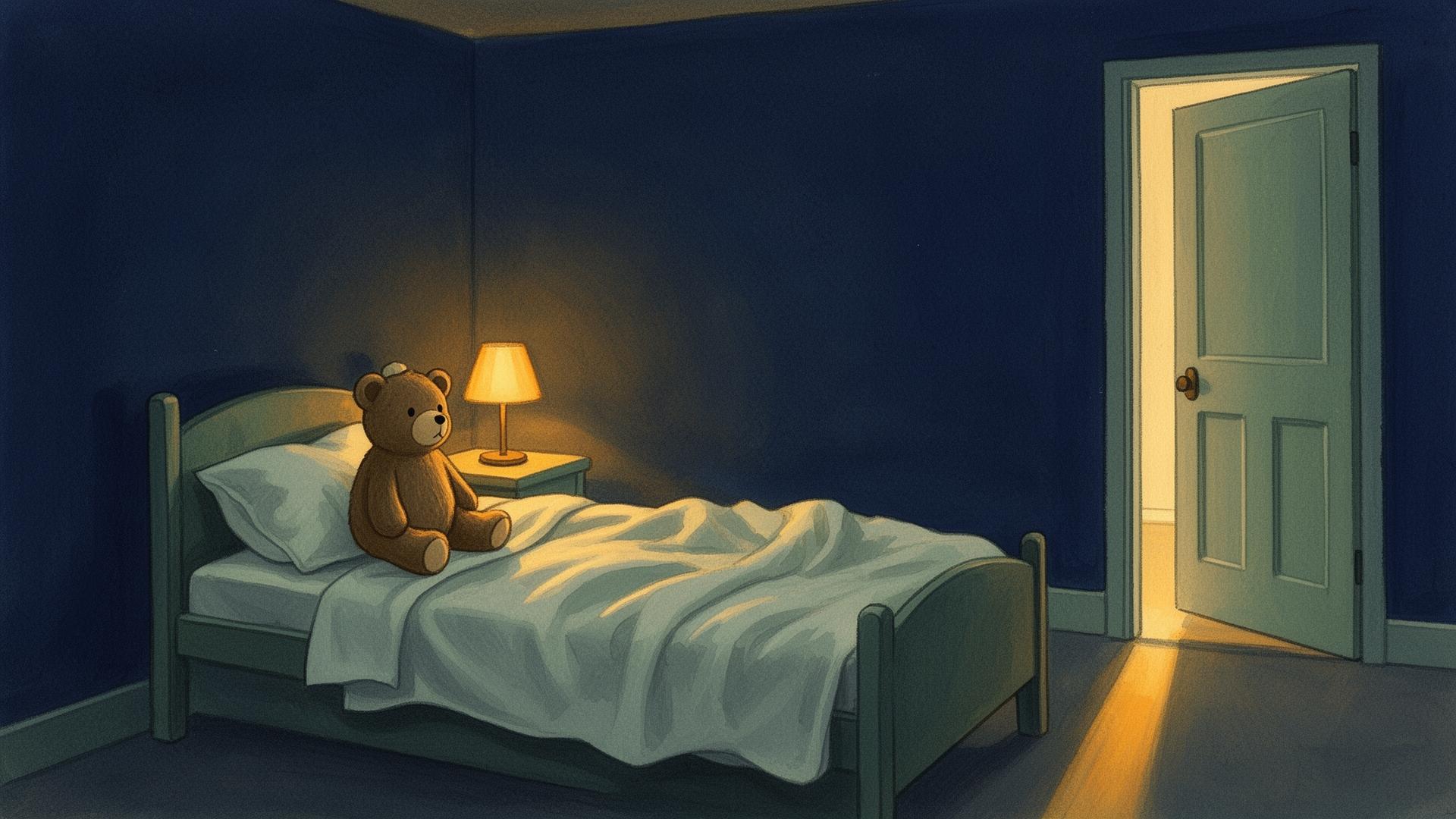
If you use a night light: amber or red, very dim, positioned to eliminate shadows rather than create them.
The actual problem — and why it is solvable
Fear of the dark disrupts sleep in a very specific way. The child is fine during the wind-down. They engage with the bath, the books, the routine. The fear activates at one moment: when you move to leave the room.
This is a [separation anxiety](/blog/18-month-sleep-regression) problem wearing the costume of a fear problem.
The child is not afraid of the dark while you are present. They are afraid of being alone in the dark. These are related but different problems — and the solution to the second one is different from the solution to the first.
What the child needs is: a consistent, predictable exit ritual that provides reassurance without negotiation. And a daytime practice that builds the emotional resource of feeling safe without constant parental presence.
What actually helps — the Lunio approach
During the day
Work on the fear during daylight, not at bedtime. At 7pm with the lights going off is the worst possible moment to process this with your child.
In the afternoon or after dinner while it is still light:
Acknowledge the fear directly and matter-of-factly. "I know the dark feels a bit scary sometimes. Lots of children feel that way."
Read books where characters face fears and feel brave. Not books about monsters — books where the character is scared of something and manages it. This builds the cognitive template for "I can feel scared and be okay."
Introduce the comfort object deliberately. A specific stuffed animal that lives on the bed and is framed as the child's companion through the night. Name it. Give it a role. "Bear stays with you and keeps watch while you sleep." This is not about the bear having real power — it is about giving the child an object that anchors their sense of safety in the room.
Practice the exit. During the day, play the bedtime routine — walk out of the bedroom, come back. Let the child see that you leave and you return. This is the daytime version of the very thing that frightens them at night.
At the exit — the most important moment
The exit ritual is where most parents give ground and create the longest-lasting problems. This is closely related to the broader issue of [bedtime resistance](/blog/bedtime-resistance).
The exit should be:
Brief — one phrase, one physical gesture, same every night. "You are safe. Bear is here. I love you. Sleep well." Then leave.
Identical — the predictability of the goodbye becomes the reassurance. A child who knows exactly what you will say and do at exit can predict the sequence, which reduces the anxiety of the unknown.
Warm but final — loving and calm, but not hesitant. A parent who pauses at the door, turns back, offers one more reassurance, then another, communicates that the exit is negotiable. The child learns to extend the sequence because it works.
If the child calls out after you leave: wait 2 minutes. If still calling, go in once. Same phrase. Same brief physical contact. Leave. Do not turn on additional lights. Do not sit on the bed. Do not engage with the content of the fear at this point.
The door position — commit to one
Parents often try different door positions — fully closed, slightly ajar, wide open — in search of the one that settles the child. This inconsistency is itself unsettling.
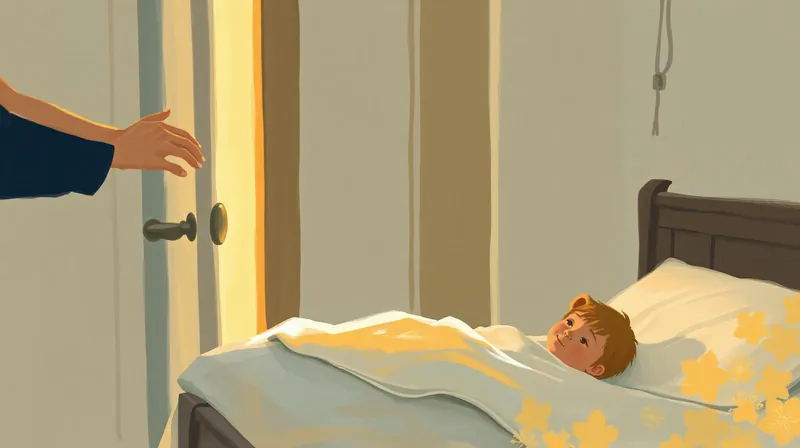
Pick a position and hold it every night. A slightly open door — enough for a thin strip of hallway light to be visible — works well for most children at this stage. The light strip is reassuring without being stimulating. The consistency of the door position becomes part of the predictable exit sequence.
Do not adjust the door position based on the child's protests. If you move the door from slightly open to fully open in response to calling out, you have taught the child that calling out produces a change in the environment. You will get more calling out.
What not to do
Do not use monster spray
Monster spray — a spray bottle of water presented as a monster deterrent — is widely recommended and consistently counterproductive.
It requires the child to accept that monsters are real enough to be sprayed away. It gives the fear an object and a ritual that reinforces rather than diminishes it. And it creates a dependency on the spray — a child who relies on monster spray to feel safe will need it every night, and will be more afraid than ever on the night you forget to do it.
Show the child what is actually in the shadows: walk to the dark corner together during the day, turn the light on and off, show them the chair or the toy or the coat that their imagination turned into something threatening. Reality is more reassuring than reassurance about imaginary threats.
Do not debate the fear's validity
"There are no monsters" is a statement about reality that the child cannot fully access yet. You can say it, but it does not land the way you hope because the child's brain is not yet fully equipped to evaluate it.
More effective: "I know it feels scary. You are safe. I love you." This is about the feeling, not the content. The feeling is real and you are acknowledging it. The content — what is or isn't in the dark — does not need to be debated.
Do not make exceptions that become new baselines
The most common pattern: the child is particularly distressed on one night, the parent stays until they are asleep, and this becomes the new expectation.
The fear is genuine. The compassionate response is completely understandable. But staying once, in a child of this age, at this stage, immediately creates an expectation for tomorrow night.
If you stay once, commit to a gradual withdrawal plan — the chair method, moving toward the door over successive nights — rather than a single exception followed by an attempt to return to normal.
Single exceptions in toddler sleep almost never remain single.
When the fear is accompanied by night waking
Fear of the dark that starts at bedtime often extends to night wakings as the child surfaces between sleep cycles, finds themselves alone in the dark, and calls out.
The response at 2am is the same as at 7pm — but shorter and quieter.
Go in after 2 minutes. Same phrase. Brief warm contact. Leave.
Do not turn on additional lights at night. The additional light at 2am signals that the environment changes in response to calling out — which is exactly the reinforcement you are trying to avoid.
If the child has a comfort object, direct their attention to it: "Bear is here. You are safe." Then leave.
When to reassess
Most fear of the dark resolves naturally between ages 5 and 7 as the child's ability to distinguish imagination from reality develops more fully. With consistent routine handling, the bedtime disruption usually settles significantly within 3–4 weeks even while the underlying fear remains.
If after 4 weeks of consistent response the fear is intensifying rather than stabilising — more distress, more night wakings, spreading to other contexts (fear of being alone during the day) — it is worth discussing with your paediatrician or health visitor.
In about 10% of cases, childhood nighttime fears are associated with generalised anxiety that benefits from specialist support. The vast majority resolve on their own with consistent, warm routine handling.
What to do tonight
- Check the exit ritual. Is it brief, identical, and warm — or is it long, variable, and hesitant? Decide on your phrase tonight and write it down.
- Introduce or reinforce the comfort object. Name it, give it a role, make it part of the goodnight sequence.
- Choose a door position and commit to it tonight and every subsequent night.
- If the child calls out after exit: wait 2 minutes, go in once, same phrase, brief contact, leave. Do not negotiate with the content of the fear.
- During the day tomorrow: acknowledge the fear in daylight, matter-of-factly. Then practice the exit during the day so the child can see you leave and return.
The fear will resolve. The routine is what carries you through it.
More on these topics
Related sleep guides
Get your child's personalised routine in 3 minutes
Answer 5 quick questions. We'll send a tailored bedtime plan and a 7-night tracker — by email, no app.
$45 one-time · No account, no app
Want more than a plan? Talk to a sleep consultant tonight — $89