BEDTIME
Toddler separation anxiety and sleep — when it's normal and when to act
Not all bedtime distress is separation anxiety. Not all separation anxiety needs the same response. Here's the distinction — and the bridge phrase that makes the goodbye feel safe rather than threatening.
In this article
The short answer
Separation anxiety often appears as repeated calling or distress when a parent leaves. A brief, predictable goodbye is easier to learn than a different response each night.
What to do
- Practise short separations during the day.
- Use one calm goodbye phrase.
- Keep reassurance visits short and low-key.
What to check
If anxiety is intense across settings or worsening over weeks, discuss it with your child’s clinician.
Your toddler is crying at bedtime. Genuinely distressed — not performing, not stalling, not applying a tactic they have learned produces results. Actually frightened that you are leaving.
Or they are performing distress they have learned produces the result they want. And you cannot tell which.
This is the central diagnostic challenge of separation anxiety at sleep. The two patterns — genuine developmental fear and learned bedtime behaviour — look almost identical from the outside. The child is distressed. The parent feels guilty. The response that helps one makes the other significantly worse.
Getting this right matters. A child with genuine separation anxiety needs a response that validates the fear while maintaining the goodbye. A child who has learned that distress produces extended parental presence needs the goodbye to happen regardless of the distress level — compassionately, but reliably.
What separation anxiety actually is
Separation anxiety is a developmentally normal fear response to the anticipated or actual absence of the primary attachment figure. It is not a sleep disorder, not a behaviour problem, and not a sign of insecure attachment. It is the correct functioning of the attachment system in a brain that has not yet fully developed the cognitive capacity to hold the concept of a temporarily absent caregiver as reliably returning.
The developmental timeline
Peak separation anxiety occurs in two distinct windows:
- 8–12 months: The first major peak. The infant has developed object permanence but has not yet developed the ability to confidently predict the caregiver's return. Out of sight genuinely means uncertain, and uncertainty activates the fear response.
- 18–24 months: The second and typically more intense peak, coinciding with the language explosion and the autonomy drive. The toddler now understands enough to know that the parent is leaving — and has enough language to make the distress known — but does not yet have the temporal reasoning to reliably hold «they always come back».
Both peaks are normal. Both peaks affect bedtime. The 18-month peak is typically more intense because the child is more capable of expressing the distress and more capable of escalating it.
If this sounds familiar, our guide Why your child keeps waking at night — and what to do about it goes deeper.
How separation anxiety presents at bedtime
- Significant escalation of distress immediately after the goodbye phrase
- Calling or crying that intensifies rather than reducing over the first 10–15 minutes
- Specific distress focused on the parent leaving rather than on getting to sleep
- Reduced distress when the parent returns to the room
- Night wakings specifically involving calling for the parent with distress, rather than general restlessness
The key distinguishing feature: the distress is specifically about the parent's departure, not about the sleep itself. The child is often content once the parent is present — even if lying in the dark — and distressed immediately on the parent's departure.
How it differs from learned bedtime behaviour
Learned bedtime behaviour — where the child has learned that distress produces parental return — presents as:
- Distress that is immediately and reliably soothed by the parent's return
- A pattern of escalation that has developed over weeks rather than appearing at a developmental milestone
- Distress that produces specific requests (water, another book, the toilet) rather than generalised calling
- A child who is calm and engaged between the distress episodes
- Distress that reduces rather than intensifies when the parent does not return quickly
Neither pattern is the child's fault. Both are responses to how the bedtime has been managed. The distinction matters because the effective response is different.
Separation anxiety at bedtime is real, developmentally normal, and transient. The child is not manipulating — they are genuinely frightened that the person they need most is leaving without certainty of return. The response that helps is not extended presence. It is a reliable signal that the parent will return — predictable, consistent, and delivered in a phrase that the child learns to trust.
The bridge phrase — making the goodbye feel safe
The bridge phrase is the core Lunio intervention for separation anxiety at bedtime. It is a specific modification to the goodbye phrase that adds a forward-looking element — a concrete, verifiable promise about return — to the standard goodbye.
Standard goodbye phrase structure
The standard goodbye phrase closes the bedtime interaction: «It is sleep time. I love you. See you in the morning.»
This is effective for routine settling. For a child with active separation anxiety, it may not be sufficient — «see you in the morning» is a long temporal horizon for a child who does not yet reliably conceptualise «morning».
Bridge phrase structure
The bridge phrase adds a near-term anchor that the child can hold:
«It is sleep time. I am going to [specific verifiable activity]. I will check on you in [specific short time]. Then see you in the morning. I love you.»
Example: «It is sleep time. I am going to make dinner in the kitchen. I will check on you in 10 minutes. Then see you in the morning. I love you.»
The bridge phrase works because it replaces «I am leaving» with «I am going somewhere specific and returning at a known time». The child is not being left — they are being left with information. The information is the bridge across the absence.
Making the bridge phrase work
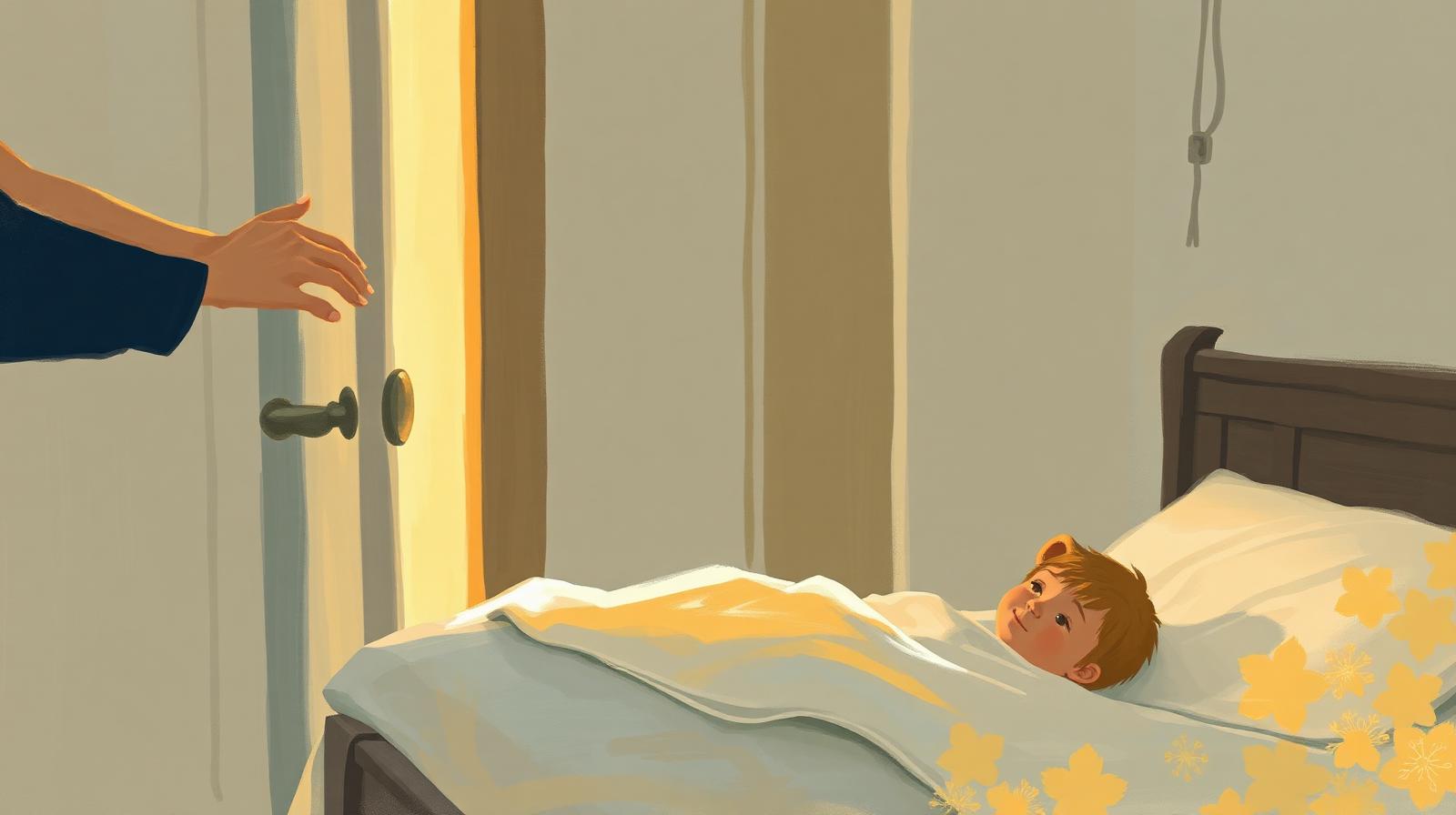
The check-in must actually happen. At the stated time — 10 minutes — the parent opens the door briefly, confirms the child is there, says «I checked on you. Sleep time» and leaves again. No additional settling, no re-engagement. The check-in is the bridge completing. Its brevity is as important as its reliability.
The time must be developmentally appropriate. 10 minutes is usually the right interval for an 18–24 month child. For an older toddler (2.5–3 years), 15 minutes may be more appropriate.
The activity must be concrete and verifiable. «I am going to the kitchen» is concrete. «I will be nearby» is not. The child can smell dinner cooking. They can hear the parent's footsteps. The concrete activity is the evidence that the bridge phrase is true.
Two types of separation anxiety at sleep — different responses needed
Type 1 — Separation anxiety at sleep onset
This is the most common presentation. The child settles (or attempts to settle) with the parent present but becomes distressed the moment the parent prepares to leave.
The bridge phrase addresses this directly. Add it to the existing goodbye sequence. Deliver the check-in reliably. Within 7–14 nights, most children have internalised the reliability of the parent's return and the check-in interval can begin to extend.
The error to avoid: staying until the child is fully asleep. This resolves the immediate distress but removes the opportunity for the child to develop trust in the bridge — to learn that the parent goes and comes back. A child who always falls asleep with the parent present never has the chance to discover that absent parents return.
Type 2 — Separation anxiety during the night
Night wakings that involve significant distress and a specific call for the parent — as distinct from general restlessness or brief wakings that self-resolve — may indicate that the separation anxiety extends beyond the initial settling.
Respond — but briefly. Go to the child. The bridge phrase for night wakings is shorter: «I am here. You are safe. I will check on you again in [interval]. Sleep time.» Leave.
Do not stay until the child is resettled. The same principle applies as at sleep onset: the child needs to learn that the parent goes and returns, not that the parent stays indefinitely.
The check-in interval at night can start shorter — 5 minutes for a very young child in a significant distress peak. Extend to 10 minutes across subsequent nights as the child calms.
When separation anxiety peaks at developmental milestones
The 18-month peak
At bedtime, the 18-month peak produces separation anxiety that is frequently mistaken for general bedtime resistance. The distinguishing feature: the child is calm during the routine and escalates specifically at the goodbye, not earlier.
The bridge phrase is the primary intervention. The routine should hold its structure. The goodbye should add the forward-looking bridge element.
The 2.5-year peak
At 2.5 years, the separation anxiety peak coincides with imaginative fear development. At this age, the child is not only anxious about the parent leaving — they may also be anxious about what is in the room after the parent leaves.
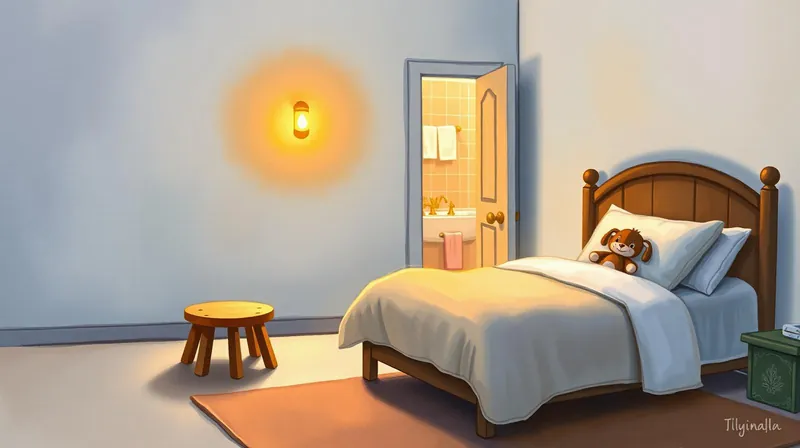
The bridge phrase addresses the first concern (parent returning). A dim warm nightlight addresses the second (room safety). Both are required at this age.
Life event peaks
Separation anxiety also spikes at life events — moving house, starting nursery, the arrival of a new sibling. These events produce genuine uncertainty that the attachment system correctly flags at bedtime.
At these moments, the bridge phrase is the most useful tool because it is the one response that directly addresses the underlying fear (will you come back?) with a concrete, verifiable answer (yes, in 10 minutes, I will check on you).
The parental guilt dimension
Separation anxiety at bedtime produces genuine guilt in most parents. Watching a child cry for you at the door, knowing that staying would resolve the distress immediately, and choosing to leave anyway requires a level of confidence in the long-term benefit that is hard to maintain in the moment.
Two things that help:
First: the child's distress at the goodbye does not indicate harm. A child who cries when the parent leaves and is asleep within 20 minutes has not been harmed. A child who learns that the parent reliably returns — because the check-in happens exactly when promised — is learning the most important fact about their world: people they depend on come back.
Second: extended presence at the goodbye does not resolve separation anxiety. It postpones it. A child who falls asleep with the parent present every night at 18 months will face the same or greater separation anxiety at 24 months when the parent eventually needs to change the arrangement. The earlier the bridge phrase is introduced, the shorter the overall period of bedtime distress.
When to get additional support
Separation anxiety that does not improve across 4–6 weeks of consistent bridge phrase use, or that is severe enough to significantly disrupt the entire family's sleep across multiple weeks, warrants a conversation with your health visitor, GP, or a qualified paediatric sleep consultant.
Additionally, seek support if:
- The separation anxiety extends significantly beyond bedtime into the day (the child cannot be out of the parent's sight without significant distress even during low-stress daytime activities)
- The child is unable to attend nursery or other care because of the intensity of separation distress
- The sleep disruption is affecting the child's daytime functioning (extreme tiredness, mood regulation difficulties, developmental concerns)
What to do tonight
If your child is showing genuine separation anxiety at bedtime:
- Add the bridge phrase to tonight's goodbye. Choose a concrete, verifiable activity: «I am going to the kitchen to make dinner.» Choose a specific time: «I will check on you in 10 minutes.»
- Deliver the check-in at exactly the stated time. Open the door briefly. «I checked on you. Sleep time.» Leave without re-engaging.
- If they are still awake at the check-in: deliver the same brief message. Do not re-start the routine.
- Extend the check-in interval by 5 minutes every 3–4 nights.
- After 7–14 nights, trial omitting the check-in and returning to the standard goodbye phrase. Most children have internalised the reliability of return by this point.
If you are not sure whether it is separation anxiety or learned behaviour: apply the bridge phrase regardless. For a child with genuine separation anxiety, the bridge phrase directly addresses the fear. For a child with learned behaviour, the bridge phrase with a brief, non-reinforcing check-in does not reward the distress — the check-in is brief, boring, and consistent. In both cases, the bridge phrase is the more effective intervention than extended presence.
More on these topics
Related sleep guides
Get your child's personalised routine in 3 minutes
Answer 5 quick questions. We'll send a tailored bedtime plan and a 7-night tracker — by email, no app.
$45 one-time · No account, no app
Want more than a plan? Talk to a sleep consultant tonight — $89