SLEEP DISRUPTION
Toddler sleep when you have a newborn — keeping the routine through the chaos
The toddler's routine is the thing most likely to survive a new baby — if you protect it deliberately. Here's how to run it solo, what to say when the baby cries mid-goodbye, and why the regression usually peaks at week 3, not week 1.
In this article
The short answer
A new sibling changes attention, noise and routines. Protect a small piece of one-to-one bedtime connection for the older child.
What to do
- Keep the routine start time steady.
- Give ten uninterrupted minutes before goodnight.
- Resume at the same step if the baby interrupts.
What to check
Judge the trend over one or two weeks; persistent daytime distress deserves broader support.
The first week with a newborn, the toddler's sleep often holds.
The grandparents are there. The novelty of the baby is exciting. Everyone is paying attention to the toddler, managing their feelings, keeping the routine as intact as possible.
Then the grandparents leave. The novelty fades. The parents are exhausted and the newborn is unpredictable. And somewhere around week 2 or 3, the toddler — who seemed to be handling everything so well — stops sleeping.
Bedtime resistance that had been resolved comes back. Night wakings return. The child who had been sleeping independently starts calling for a parent to lie down with them. The routine that took months to build appears to have evaporated.
This is not the toddler regressing. This is the toddler correctly reading that the new family configuration has changed the rules — and testing to find out what the new rules are.
Why a new sibling disrupts toddler sleep
The attention economy has fundamentally shifted
Before the baby, the toddler had a predictable claim on parental attention. Bedtime was a known ritual — the parent was present, focused, and available.
After the baby, parental attention is unpredictable. The parent may be interrupted at any moment. They may be visibly tired, distracted, or emotionally unavailable in ways the toddler has never experienced before.
If this sounds familiar, our guide The 5-night toddler sleep reset — get any routine back on track goes deeper.
Bedtime is particularly vulnerable to this shift. The toddler has learned — correctly — that calling out after lights out now has a higher probability of producing a parent than it did before. The newborn's needs are clearly rewarded immediately and publicly. The toddler is applying the same logic.
The routine has been disrupted during the postpartum period
Hospital stays, recovery periods, the logistical chaos of early newborn weeks — all of these disrupt the toddler's routine in ways that are genuinely outside anyone's control. A routine that is interrupted for 7–14 days develops gaps. The gaps become the new normal if they are not actively closed.
The toddler's feelings about the sibling are complicated
Most toddlers feel some combination of love, curiosity, jealousy, and confusion about the new sibling. These feelings do not disappear at bedtime — they surface there, in the dark, when there is nothing else to focus on. The child who is asking for water at 9pm is not thirsty. They are processing.
This is not manipulative. It is developmentally appropriate. The response — warm, brief, consistent — is the same as it would be for any other bedtime stalling. But understanding the emotional substrate makes the consistency easier to maintain with compassion rather than frustration.
The week 3 peak — why it catches families off guard
Most sleep disruption after a new sibling peaks not in week 1 — when the disruption is anticipated and everyone is on alert — but in weeks 2–4, when the sustained reality of the new family configuration is fully felt.
- Week 1: Novelty, grandparents, everyone vigilant. Often deceptively smooth.
- Week 2: Reality sets in for the toddler. First signs of bedtime resistance.
- Week 3: Peak disruption. The toddler has fully understood that the old rules have changed and is testing the new ones with maximum persistence.
- Week 4 onwards: With consistent response, the disruption begins to resolve.
The toddler's sleep regression after a new sibling is not a regression. It is information. The child is telling you that the rules feel different and they need to know whether the old rules — the ones that worked, the ones that meant the routine was consistent and the goodbye phrase was the end — still apply. The answer to that question, delivered consistently across nights, is the intervention.
The parallel routine — running the toddler's bedtime solo
The most common structural failure after a new baby: the toddler's bedtime routine is consistently interrupted or abbreviated because the newborn needs something at the wrong moment. After several weeks of this, the routine has been effectively dismantled.
The parallel routine is the solution. It requires accepting one hard constraint: the toddler's routine takes priority over the newborn's needs for the 35–45 minutes it runs. Everything else can wait.
How to run the parallel routine
Timing: Start the toddler's routine at the usual time, or 15–20 minutes earlier than usual to buffer for disruptions. Earlier is almost always better with a newborn in the house.
The newborn: fed and settled before the toddler's routine begins, or held by a second parent or support person during it. If you are doing this alone: the newborn goes in a safe sleep space (cot, bassinet) for the duration of the routine. A crying newborn in a cot for 35 minutes is not harmed. A toddler routine interrupted every 10 minutes for 4 weeks produces a sleep regression that takes months to resolve.
The sequence: identical to the pre-baby routine. Bath, pyjamas, teeth, books, goodbye phrase. In that order. At the same pace.
The goodbye phrase: said once, clearly, at the end. Not «I need to go check the baby» — «It is sleep time. I love you. See you in the morning.» The phrase signals the end of the interaction. The baby is not the reason the interaction is ending. The routine is.
The moment the baby cries mid-goodbye
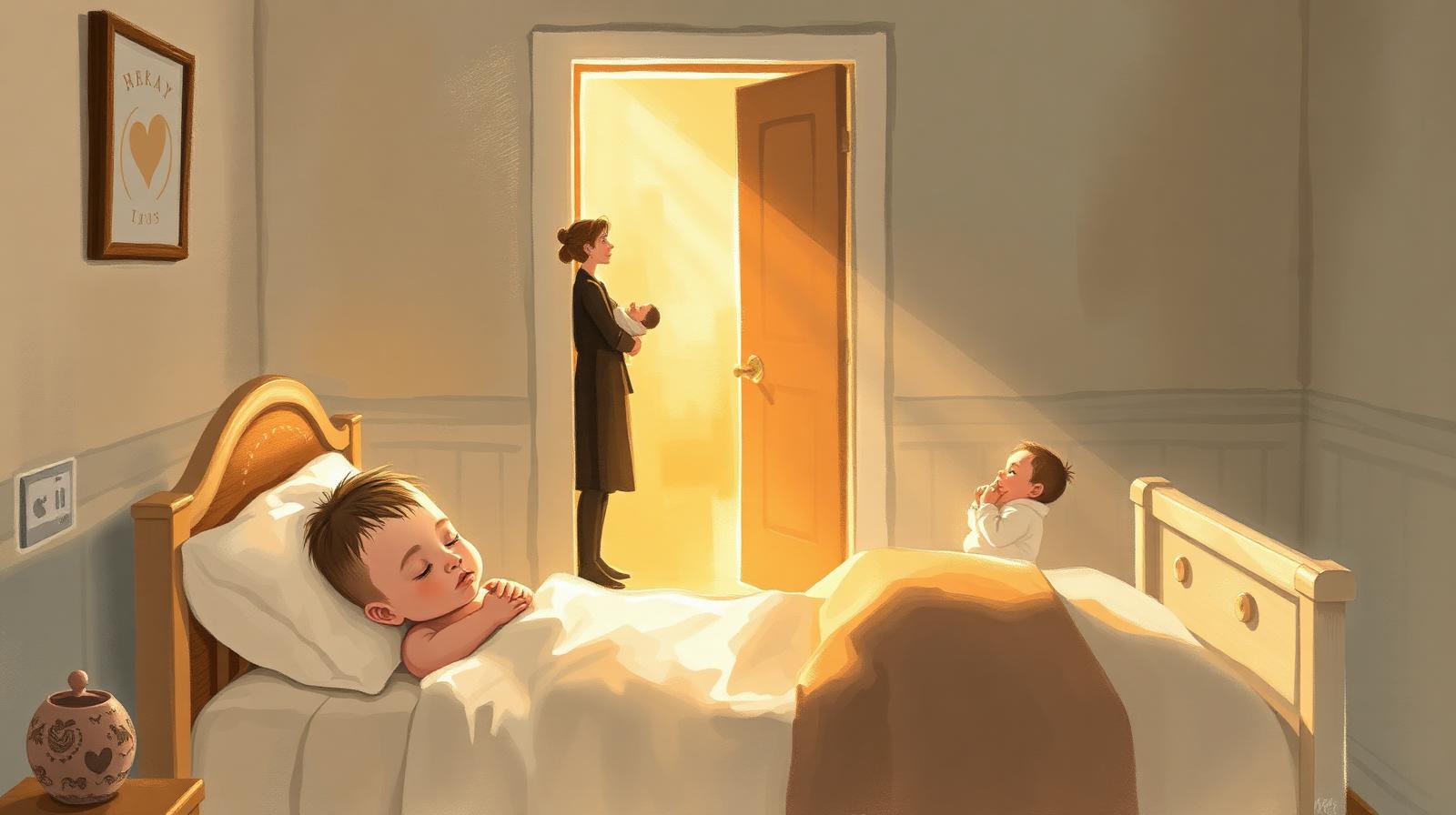
This is the moment most parents feel they have no good options. The toddler is in bed. You are at the door. The newborn starts crying loudly in the next room.
Script: «The baby needs me. I love you. Sleep time.» [Leave.]
Not «I'll be right back, just let me check the baby.» Not «Don't worry about the baby, I'm coming back.» Not returning after 3 minutes to check on the toddler.
The toddler has understood that the baby's cries produce the parent's immediate return. Testing whether their own calls also produce the parent's return is logical. The answer — delivered consistently by completing the goodbye and not returning — is that the routine applies regardless of the baby.
This is hard. It requires accepting that the toddler will call out and that you will not immediately return. The newborn's cries make the toddler's settling harder regardless. But returning mid-goodbye teaches that calling after the phrase produces a parent. Within a week of consistent non-return, most toddlers accept the phrase as the final exit.
Scripts for the specific situations
«I want to see the baby»
During the day, make the baby as accessible and as included in the toddler's world as possible. The bedtime request for the baby is almost always a stalling tactic rather than a genuine need — the same child who has been with the baby all day does not urgently need to see them at 19:30.
Script: «You'll see the baby tomorrow. Sleep time.»
«The baby is keeping me awake»
If the newborn's nighttime feeding genuinely disturbs the toddler:
- White noise in the toddler's room is the most effective practical solution. It masks the newborn's feeding sounds significantly.
- If rooms are adjacent, consider whether temporary alternative sleeping arrangements (the toddler in a different room, or white noise positioned between the rooms) help during the worst of the newborn period.
Script for when they complain: «I know the baby makes sounds at night. Your room is the sleep room. Sleep time.»
«Can you stay with me like you stay with the baby»
This is the most emotionally loaded version of the bedtime challenge after a new sibling. The toddler has accurately observed that the newborn receives extended parental presence at night and is requesting equivalent treatment.
The honest answer — which you do not say — is that the newborn receives extended presence because it is developmentally required, not because presence at night is a reward for being young.
The script: «I love you. The baby needs something different at night than you need. You know how to sleep in your bed. That is something to be proud of. Sleep time.»
Say it warmly. Mean it. The child who can sleep independently is genuinely capable in a way the newborn is not. Naming that capability with genuine warmth — not as a dismissal — is often the most effective response to this specific request.
«I'm scared»
Fear at bedtime often increases after a new sibling, for reasons that are partly developmental (the 2–3 year imaginative fear window) and partly emotional (the new sibling has introduced uncertainty into the world, and uncertainty at bedtime becomes fear in the dark).
Script: «I know it can feel a bit scary. You are safe. [Comfort object] is with you. Sleep time. I love you.»
Acknowledge once. Use the phrase. Leave. Do not re-enter specifically for fear claims unless the distress is genuinely intense. The pattern of fear claim → parent return reinforces the behaviour.
The night wakings after a new sibling
Night wakings that return after months of sleeping through are one of the most demoralising aspects of post-baby toddler sleep. The parent who is already managing a newborn's night feeds now has a toddler waking at 2am as well.
The response must be brief, consistent, and identical: go to the toddler's room (not the parental bed). Brief, calm, warm — the goodbye phrase. Exit. Same response every time.
The most common error: bringing the toddler into the parental bed on the nights when the newborn is also awake and the parent is at their most depleted. This resolves the immediate problem and creates a month of re-establishing that the toddler sleeps in their own bed.
If the partner is available: divide responsibilities on the harder nights. One parent manages newborn feeds. The other manages toddler wakings. The consistency of the response matters more than which parent delivers it, provided the response is identical.
The special time deposit
The most effective preventive measure for post-baby toddler sleep disruption is also the one most frequently deprioritised: 15–20 minutes of undivided one-on-one time with the toddler every day, before the evening routine, that is explicitly not about the baby.
This time should be:
- Child-led — they choose the activity
- Screen-free
- Genuinely undivided — phone away, baby with other parent or settled
- Named: «This is your special time»
The function of special time is not primarily emotional (though it is that too). It is sleep-functional: a toddler who has had a guaranteed daily deposit of undivided parental attention has less need to extract it from bedtime. The bedtime resistance that is essentially attention-seeking reduces significantly when the attention need is met earlier and more predictably.
15 minutes of special time before dinner. The routine then proceeds as normal. The toddler's attention account is not empty when lights go out.
When the regression predates the birth
Some toddlers begin showing sleep disruption during the pregnancy — in the weeks or months before the sibling arrives. This is earlier than most parents expect.
The cause is the same: the toddler has read the signals — the changed household atmosphere, the parental discussions, the visible physical changes — and their nervous system is responding to anticipated change.
The intervention is the same: hold the routine, use the phrase, protect special time. The sleep disruption that begins during pregnancy and is addressed consistently before the birth is typically shorter and less intense than the disruption that develops after the birth and is allowed to consolidate.
What to do tonight
If the newborn arrived in the last 1–3 weeks:
- Restart the toddler's routine at the correct time tonight, even if it has been abbreviated or disrupted. Run the full sequence.
- Feed and settle the newborn before the toddler's routine begins, or place them safely in a cot for the duration.
- Use the goodbye phrase and leave. Do not return for 10 minutes after the phrase unless the distress is genuine and intense.
- Schedule 15 minutes of special time tomorrow before dinner.
If the regression is already established (3+ weeks): the 4-week holding period applies. Run the routine identically for 28 consecutive nights. Night 3 and night 7 will likely be the hardest. Hold through both. The disruption typically reduces meaningfully by night 10 and resolves by night 21–28 with consistent response.
More on these topics
Related sleep guides
Get your child's personalised routine in 3 minutes
Answer 5 quick questions. We'll send a tailored bedtime plan and a 7-night tracker — by email, no app.
$45 one-time · No account, no app
Want more than a plan? Talk to a sleep consultant tonight — $89