SLEEP DISRUPTION
Toddler sleep in summer — blackout blinds, heat and light until 10pm
Summer disrupts toddler sleep through light, heat, and late evenings simultaneously. Here's how to create the conditions for sleep when the sun disagrees — and why the blackout blind is the single most important purchase for European families.
In this article
- 01The light problem — why summer evenings disrupt toddler sleep
- 02Choosing the right blackout solution
- 03The heat problem — why bedroom temperature matters
- 04The schedule problem — late summer evenings and irregular days
- 05Early rising in summer — the 5am wake-up problem
- 06The complete summer sleep checklist
- 07What to do this week
In January, your toddler goes to bed at 19:00 in a dark, cool room. The conditions for sleep are largely created by the season itself.
In July, at 19:00, it is bright outside, potentially 26°C in the bedroom, and the neighbours are in the garden. You are trying to create the conditions for sleep that winter provides automatically — in a room that is actively fighting you.
This is the European summer sleep problem. It is not one problem. It is three simultaneous forces acting on the toddler's biological clock at once:
- Light — suppressing the melatonin that makes sleep possible.
- Heat — disrupting the temperature drop that accompanies sleep onset.
- Schedule disruption — late family evenings, holidays, irregular days.
Each of these has a specific solution. None of the solutions requires abandoning the schedule or accepting that toddler sleep will be bad from June to September.
The light problem — why summer evenings disrupt toddler sleep
The biology of light and melatonin at latitude
In most of northern and central Europe — the UK, France, Germany, the Netherlands, Scandinavia, Denmark, Norway — sunset in late June occurs between 21:00 and 23:00 depending on latitude. In southern Scandinavia, this means full dusk does not arrive until 22:30. In Edinburgh, sunset on the summer solstice is after 22:00.
Your toddler's melatonin system responds to the same light cues it uses in winter — except in summer, those cues are arriving 4–5 hours later in the evening. The body does not know it is supposed to be 19:00 on a Tuesday in July. It knows that the light level outside the window says «mid-afternoon».
Without intervention, a toddler in a bright room at 19:00 in July will have significantly suppressed melatonin compared to the same toddler in a dark room at the same time in December. The settling conditions are genuinely worse because the biology has not received the signal that evening has arrived.
If this sounds familiar, our guide The 5-night toddler sleep reset — get any routine back on track goes deeper.
The artificial dusk method
Artificial dusk is the deliberate creation of the sensory conditions of evening regardless of what the external light environment is doing. It has two components:
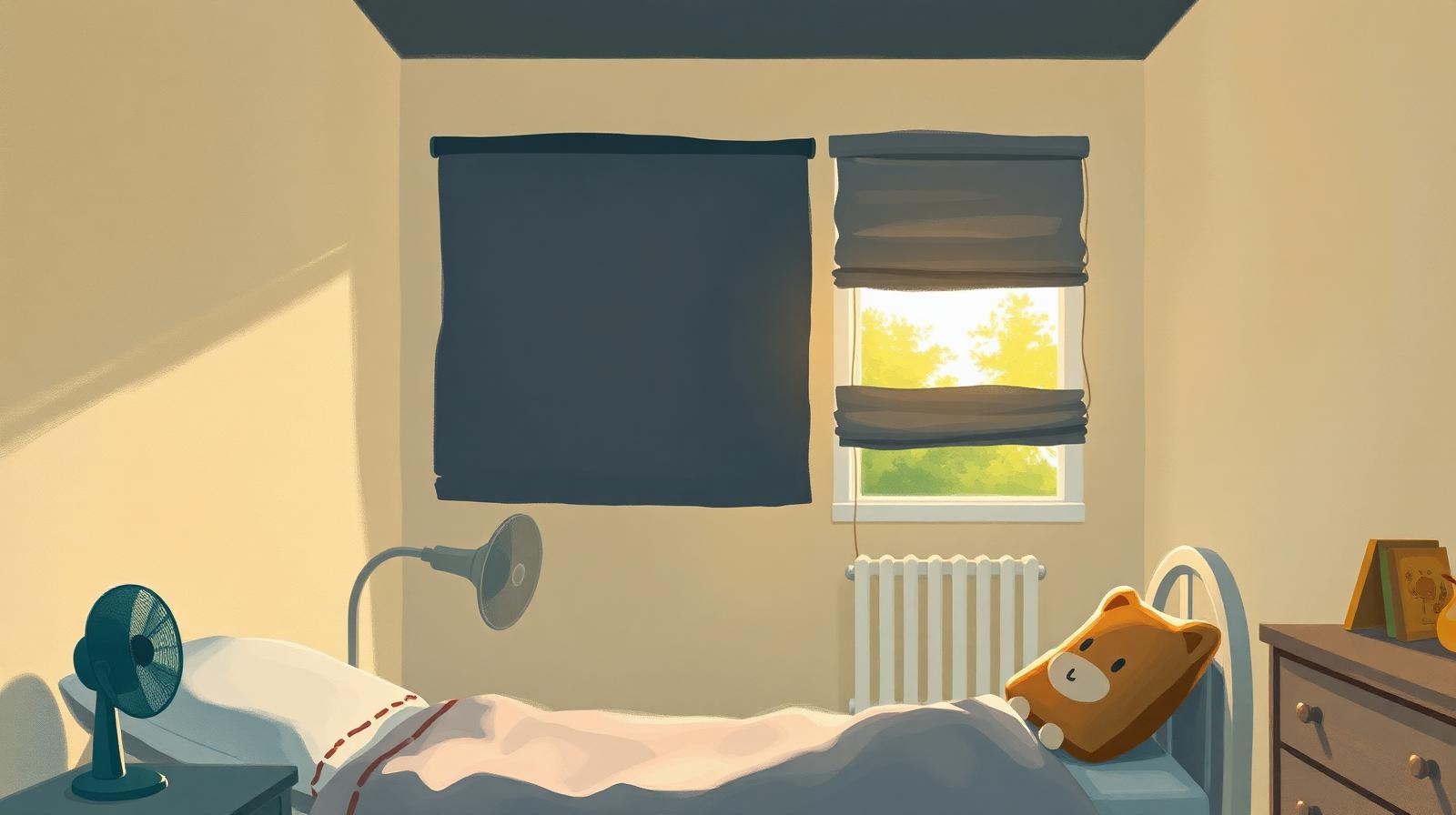
Component 1 — Blackout the bedroom from 17:30. The bedroom should be fully dark — not dim, dark — from 90 minutes before bedtime. This is the most important single intervention for summer sleep. The goal is a room dark enough that the child cannot see clearly when lying in bed. This level of darkness allows melatonin to rise on its normal schedule despite the external light environment.
Component 2 — Dim all household lights from 18:00. The household light environment in the 90 minutes before bedtime matters as much as the bedroom environment. An LED-lit kitchen and living room at full brightness until 18:45 is delivering the same melatonin-suppressing blue light as a screen. Dimming to 50% or below and switching to warmer-spectrum lamps from 18:00 recreates the light gradient of a natural evening descent.
Together, the blacked-out bedroom and the dimmed household create an artificial dusk — the sensory experience of a summer evening that is developmentally indistinguishable from a winter evening.
The blackout blind is not about keeping summer light out of the room at night. It is about creating the melatonin conditions of winter in the middle of July. Once the room is dark enough at 17:30, your toddler's biology cannot tell what month it is. That is exactly what you want.
Choosing the right blackout solution
Not all blackout solutions are equal. The standard blackout curtain liner sold in most homeware shops blocks approximately 85–90% of light. This is not sufficient for the Nordic or northern European summer at high latitude. The sliver of orange light around the curtain edge at 21:00 is enough to delay melatonin onset.
What adequate blackout looks like
The test: in the blacked-out room at the time of maximum summer sunset light, hold your hand in front of your face. If you can see it clearly, the blackout is insufficient.
True blackout — the level needed for summer toddler sleep — means essentially no visible light in the room from any source. This requires blackout fabric (not liner, but dedicated blackout fabric or cellular blind) that blocks 99%+ of light, AND coverage of any gaps around the edges of the window frame, not just the window itself.
The gap between a curtain and the wall at either edge — typically 3–5cm — allows enough light in for melatonin suppression even when the curtain itself is blackout quality.
Practical solutions by window type
- Standard window with curtain pole: Install blackout eyelet curtains using a wrap-around curtain pole, or use blackout curtain tape along the wall edges to eliminate the side gap. A pelmet eliminates the top gap.
- Sash or casement window without curtain: A roller blackout blind fitted into the window reveal (close-fitting to the frame) is more effective than curtains for eliminating side gaps.
- Rented property or temporary solution: Suction-cup blackout blinds work well on smooth window glass and are completely removable. The Gro-Anywhere Blind and similar products are designed specifically for this application.
- Travel: A portable blackout blind or blackout travel sheet is essential for holiday sleep.
The heat problem — why bedroom temperature matters
The temperature drop mechanism
Sleep onset is accompanied by a drop in core body temperature of approximately 1–2°C. This temperature drop is not a consequence of sleep — it is a precondition of it. The body cannot fully enter deep sleep without the core temperature reduction.
In summer, a bedroom at 26–28°C does not allow this temperature drop to occur adequately. The body is trying to cool while the environment is retaining heat. Settling takes longer. Deep sleep stages are shorter. Night wakings increase.
The target bedroom temperature
The research-supported optimal bedroom temperature for toddler sleep is 16–20°C. The practical gradient: below 20°C is ideal, 20–22°C is acceptable, above 24°C is genuinely disruptive to sleep quality. Above 26°C, settling difficulty and increased night wakings are expected regardless of other interventions.
Practical cooling methods
- Cross-ventilation: open windows on opposite sides of the home during the cooler part of the day. Close all windows, blinds, and curtains on sun-facing sides during the hottest part of the day (11:00–17:00).
- Electric fan: a fan does not cool the air but increases evaporative cooling from the skin. Position facing the window to draw warm air out rather than facing the child.
- Cool damp towel over the fan: places moist air circulation in the room, effective on dry heat nights.
- Pre-cooling the bedroom: close the blackout blinds in the child's room from mid-morning to prevent solar heat gain. A blacked-out room is also a cooler room.
Dressing for summer sleep
- Above 24°C: a short-sleeved onesie or a vest and nappy. No sleeping bag. No blanket.
- Between 20–24°C: a thin cotton sleeping bag (0.5 tog) or a light cotton sheet.
- Between 16–20°C: the normal season-appropriate sleeping bag or pyjamas and sheet.
Signs the child is too hot at night: sweating, flushed skin, restlessness, waking frequently.
The schedule problem — late summer evenings and irregular days
The later natural tired time
Even with perfect blackout and a cool room, summer produces a biological challenge to the schedule: the circadian clock, influenced by the extended daylight, shifts the natural onset of evening tiredness later. A toddler who normally becomes naturally tired at 18:30 may not reach the same fatigue level until 19:30 or 20:00 in midsummer.
The practical adaptation: allow a 30-minute seasonal bedtime adjustment in midsummer. A 19:30 bedtime in July, returning to 19:00 in September, is a proportionate response to the biological shift. More than 30 minutes later risks overtiredness — especially when the nap has also shifted.
Holiday and event-driven late nights
Summer brings a higher frequency of late evenings than any other season. The morning anchor method applies here with particular force: hold the morning wake time within 30 minutes of normal after any late night, regardless of how late the previous evening ran.
The summer-specific compounding risk: multiple consecutive late nights during a holiday week produce biological clock drift that does not correct without the 3-day recovery protocol. One late night per week is manageable. Four or five consecutive late nights in a holiday week require a deliberate 3-morning recovery.
The nap in summer
Two summer-specific nap disruptions: the nap in a warm car (a toddler who falls asleep at 17:30 and wakes at 18:00 has had a problematic transition nap — too short, too late, too close to bedtime); and the nap skipped for a beach afternoon (a toddler who misses the nap for a full outdoor afternoon in summer heat is significantly overtired by 17:00). Move bedtime to 18:30 on any day the nap was missed or significantly shortened.
Early rising in summer — the 5am wake-up problem
The summer early riser is a specific and extremely common problem in northern Europe. The light levels at 4:30–5:00am in midsummer are sufficient to produce a full melatonin suppression — effectively a dawn signal to the circadian clock — in a room without adequate blackout.
The toddler who was sleeping until 7:00 in January and is waking at 5:00 in July is not in a regression. The early rising is the biological clock responding to the correct dawn signal, which happens to be arriving 90 minutes earlier than the parent would prefer.
The solution is exclusively environmental: blackout the room adequately. The room must be dark enough that the 4:30am light outside does not penetrate. Once the room is adequately dark, the biological clock does not receive the dawn signal at 4:30am and the child sleeps until the established wake time.
There is no behavioural intervention that works for light-driven early rising. The early rising will not resolve through routine adjustment, later bedtimes, or graduated responses to the early waking. The light is the cause. The blackout is the intervention.
The complete summer sleep checklist
Environment:
- Bedroom fully blacked out — true blackout (99%+), including side and top gaps
- Bedroom pre-cooled during the day (blinds closed from mid-morning)
- Bedroom temperature below 22°C at bedtime if possible
- Electric fan for air circulation if above 22°C
- Child dressed appropriately for bedroom temperature
- Household lights dimmed from 18:00
Schedule:
- Screen-off time maintained at 90 minutes before bedtime
- Bedtime adjusted 30 minutes later if needed (midsummer adaptation)
- Morning wake time held within 30 minutes of usual after any late night
- Nap timing protected — not allowed to drift past 15:00
- Early bedtime (18:30) on any day nap was missed or cut short
What to do this week
If early rising is the problem: address the blackout first. A room with genuine blackout at 4:30am will not produce a 5am waking. Check side and top gaps specifically — these are almost always the source of the light causing the early wake.
If settling is taking more than 30 minutes: check the bedroom temperature at 19:00. If above 24°C, cooling is the priority. Introduce the artificial dusk sequence: dim household lights at 18:00, begin the wind-down at 18:15, enter the already-dark bedroom at 18:45.
If the schedule has drifted: apply the morning anchor method. Hold wake time, protect nap timing, accept a summer bedtime 30 minutes later than winter. For extended holiday drift, apply the 3-day morning anchor recovery.
More on these topics
Related sleep guides
Get your child's personalised routine in 3 minutes
Answer 5 quick questions. We'll send a tailored bedtime plan and a 7-night tracker — by email, no app.
$45 one-time · No account, no app
Want more than a plan? Talk to a sleep consultant tonight — $89