SLEEP DISRUPTION
Toddler sleep on holiday — how to keep the routine away from home
The routine is not a place. It is a sequence, a phrase, and a comfort object. All three travel. Here's what to pack, what to let go, and what to do on night 1 in a new room.
In this article
You spent three months building the routine. It works. Your toddler settles in 10 minutes, sleeps through, wakes at a reasonable hour.
Then you go on holiday, and on night 1 in the rental apartment it falls apart completely.
Not because the routine is fragile. Because you left three quarters of it at home.
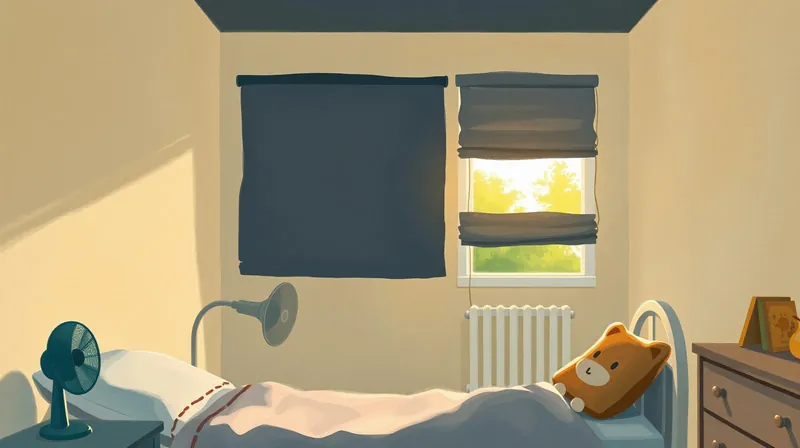
The sleep environment your toddler has at home — the specific blackout blind, the exact darkness level, the familiar smells, the known sounds of the house at night — is doing more sleep work than most parents realise. Remove it entirely and the child is settling in what is, from their nervous system's perspective, a completely unknown environment.
The good news: the routine does not need the room. It needs four specific elements that travel in a bag. Pack those four things correctly, deploy them in the right order on night 1, and most toddlers settle within two nights of arriving somewhere new.
Why toddler sleep falls apart on holiday
The environment is unknown
Your toddler's sleep is partly triggered by environmental cues — the specific darkness of their room, the familiar ambient sound of your home, the smell of their bedding, the feel of their mattress. These cues are so embedded in the settling sequence that the child barely knows they are using them.
In a new environment, every one of these cues is absent or wrong. The darkness level is different (holiday accommodation is rarely as dark as a blacked-out nursery). The sounds are different. The smells are different. The sleep surface is different. The child's settling system is looking for its normal triggers and finding none of them.
If this sounds familiar, our guide The 5-night toddler sleep reset — get any routine back on track goes deeper.
The schedule has shifted
Travel — particularly across time zones, but also just the disrupted days of getting to a destination — typically pushes bedtime later and nap timing off. A child who is overtired and in an unfamiliar environment is the most difficult settling combination possible.
The social stimulation is higher
Holidays typically involve more people, more activities, more noise, and later evenings than normal home life. The stimulation load arriving at bedtime is significantly higher than usual — and the wind-down period, in the middle of a lively evening with family or friends, is correspondingly harder to create.
The parent is also off-routine
Holiday is a rest from the structure of normal life. The parent who is precise about dimming lights at 17:30 and starting the bath sequence at 18:15 at home is significantly more relaxed about all of this in a holiday apartment. The child's routine depends partly on the parent's consistency — and holidays erode that consistency.
The routine is not the room. It is not the specific blackout blind or the white noise machine plugged into the same socket. The routine is a sequence, a phrase, a comfort object, and a wind-down environment that you can recreate anywhere. Pack those four things. The room is irrelevant.
The four non-negotiables that travel
These four elements are what the routine actually depends on. Everything else — the nursery, the specific darkness level, the familiar house sounds — is context. These four are the mechanism.
Non-negotiable 1 — The comfort object
One specific object that lives in the child's sleep space and travels with them. Not a rotation of toys. One object, always the same, associated only with sleep.
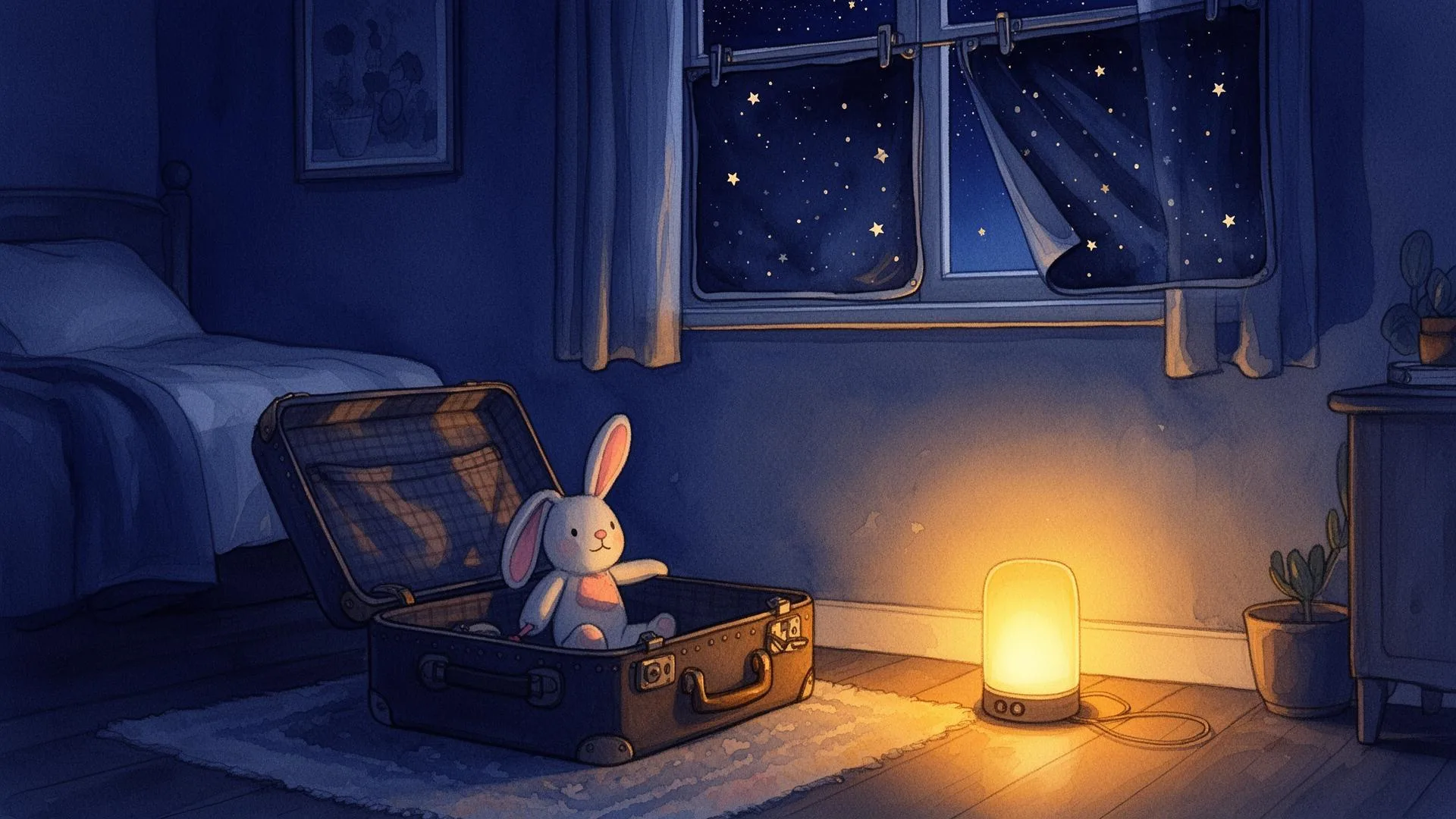
This object carries the olfactory and tactile cues of the home sleep environment into the holiday room. The child who has been sleeping with the same soft rabbit for 8 months will find the rabbit's familiar smell and texture in an otherwise unfamiliar room. This is the most powerful single item you can bring.
Rule: do not wash the comfort object in the week before the holiday. The familiar smell is the feature, not the bug.
Non-negotiable 2 — The goodbye phrase
One phrase, said identically at the end of every routine everywhere. «It is sleep time. I love you. See you in the morning.»
The phrase is a conditioned sleep trigger. After weeks of consistent use, it signals to the child's nervous system that the settling is complete and sleep follows. It works in a rental apartment in France in August as well as it works in the nursery at home — because the trigger is the phrase, not the room.
The only requirement: it must be the same phrase used at home, said in the same way, with the same final exit. Do not improvise a softer version because you feel guilty about leaving them in a strange room.
Non-negotiable 3 — The wind-down sequence
The sequence of steps that precedes lights out at home — whether that is bath, pyjamas, teeth, books, or a shortened version of it — must happen in the same order on holiday.
This does not mean a full bath every night. It means the sequence of steps that immediately precede the goodbye phrase must be consistent. Pyjamas, teeth, two books, goodbye phrase — in that order, in that room, every night.
The sequence is the biological signal. The room is where it happens to occur.
Non-negotiable 4 — The darkness
This is the one environmental factor that matters enough to pack something for it. Holiday accommodation is almost always insufficiently dark — thin curtains, light under doors, streetlights through windows.
Options in order of effectiveness:
- A portable blackout blind (suction cup versions work on most windows, pack flat, cost under $23)
- Blackout travel sheets that attach over existing curtains with clips
- Gaffer tape around the edges of curtains (ugly but effective)
- A sleep mask for children old enough to tolerate one (typically 3+)
The darkness level does not need to be perfect. It needs to be dark enough that the child cannot see clearly when lying in bed. Streetlight coming under a door is not a problem. A full window of orange glow at 9pm is.
Night 1 in a new place — the deployment sequence
Night 1 is the hardest and the most important. The choices made on night 1 set the expectation for every night of the holiday.
Arrive early enough to do the routine
This is the most commonly violated principle of holiday sleep. Families arrive at the holiday apartment at 21:00 — the child is overtired, overwhelmed, and the routine is compressed to nothing. The settling fails, the parent stays in the room, and the pattern for the rest of the holiday is set.
If at all possible: arrive by 17:00. Allow one hour of low-stimulation exploration of the new space. Begin the wind-down at the normal time. Run the full routine.
If arrival is unavoidably late: run an abbreviated version of the routine — pyjamas, two minutes of a familiar book, comfort object, goodbye phrase. Accept that night 1 will be harder. Do not stay in the room. The goodbye phrase is the exit cue; use it even on night 1.
Let the child explore the sleep space before the routine begins
Fifteen minutes of low-stimulation exploration of the bedroom before the routine starts reduces the novelty of the environment. The child has walked around it, touched the bed, identified where the door is. It is no longer completely unknown.
Do not make this exciting. «Let's look at your bed!» with enthusiasm adds stimulation. «Here's where you're sleeping» in a matter-of-fact tone, followed by allowing the child to investigate at their own pace, is the right approach.
Set up the comfort object before the routine begins
The comfort object should already be on the bed when the exploration happens — not produced at the end of the routine as a reward. It is part of the environment from the start, not a transition tool.
Run the sequence identically
Bath or equivalent, pyjamas, teeth, books, goodbye phrase. In that order. In the new room. With the comfort object present. With the darkness as good as you can make it.
The child is settling in a new environment with a familiar sequence. The sequence is doing the work.
Use the goodbye phrase and leave
This is where most parents deviate on night 1. The impulse to stay longer, to offer extra reassurance, to lie down beside them — because it is a new place and it feels unkind to leave — is understandable and almost always counterproductive.
Staying longer on night 1 sets the expectation that staying longer is available. Night 2 then requires longer. Night 3 longer still.
Use the phrase. Leave. If they call out: wait two minutes, return once, phrase again, leave. This is night 1 in a new place, not night 1 of introducing a new routine.
Managing the holiday schedule
The nap on holiday
If the child still naps: try to maintain the nap at the same time and in the same sleep space (the travel cot or the bed in the apartment) as the night sleep. A nap in a different location — the buggy, the car, a beach shade — produces lighter, shorter sleep and reduces night settling quality.
If the nap happens at the wrong time due to travel or activities: move bedtime earlier to compensate for the reduced or late nap. The same rule applies on holiday as at home: nap ending after 15:00 requires a bedtime adjustment.
Later evenings on holiday
Holiday evenings with extended family, restaurants, and later general schedules frequently push toddler bedtime later. An occasional late night (30–45 minutes past usual) on a holiday is manageable. Three or four consecutive late nights produce a cumulative overtiredness that makes the last days of the holiday — and the return home — significantly harder.
The practical approach: protect the routine on most nights and choose which evenings the later night is acceptable. One later night mid-holiday is a minor disruption. Every night later is a week-long overtired cycle.
Time zone changes
For short trips (less than 3 hours of time difference): do not attempt to shift the schedule to the local time zone. Run the routine at home bedtime in local terms — which will be earlier or later than the local norm but will avoid the disruption of shifting the biological clock for a short trip.
For longer trips (3+ hours of time difference): the clock change post approach applies — shift the schedule 15 minutes per day in the direction of the destination time zone, starting before departure if possible.
Sharing a room
Many holiday situations involve the child sharing a room with parents — in a smaller apartment, a single hotel room, or a family member's spare room.
This is the highest-risk situation for introducing a new comfort association. The child can see the parent in the room and will call for them. The parent, trying not to wake the rest of the household, responds immediately and quietly — which reinforces the calling.
The approach for room-sharing on holiday:
- Create a visual or physical divider if possible — a travel cot beside a wardrobe, a curtain across part of the room, any arrangement that reduces the child's visual access to the parent after lights out.
- Run the routine normally. Use the phrase. Lie down (or pretend to) on your side of the room. Do not respond to every call — wait the same 2 minutes you would at home.
- Accept that room-sharing will produce more waking than the home sleep space. The goal is not to replicate home settling exactly. It is to avoid installing a room-sharing comfort pattern that will persist once you return home.
Getting back to normal after the holiday
The return home is usually easier than anticipated. The home environment triggers the familiar cues — the specific darkness, the familiar sounds, the known comfort of the home mattress — and most toddlers settle better on the first night home than on the last night of the holiday.
If the holiday has been long (2+ weeks) and the schedule has drifted significantly, the first 2–3 nights home may require a reset. Run the routine identically for 5 nights at the correct home schedule. Most children return to pre-holiday settling within 3–5 nights.
If a new comfort pattern was established on holiday (parent staying in room, co-sleeping, being fed to sleep again): the 3-night re-entry method from the illness post applies here too. Night 1 — abbreviated presence. Night 2 — brief return if called. Night 3 — normal.
What to pack
Sleep kit checklist for travelling with a toddler:
- The comfort object (unwashed)
- Portable blackout blind or travel blackout sheet
- The two books used in the routine at home
- A white noise app downloaded on your phone (if used at home)
- The child's own pillow and pillowcase (optional but effective — familiar smell)
- Age-appropriate pyjamas for the destination temperature
That is the list. Everything else is context.
What to do tonight if you leave tomorrow
- Pack the comfort object last — it should not be accessible during the day before departure.
- Confirm you have a portable blackout solution.
- Plan the arrival time: will you arrive by 17:00? If not, what is the abbreviated routine you will run?
- Decide which evenings of the holiday will be the later nights.
- Remind yourself: the phrase works everywhere. The routine works everywhere. The room is irrelevant.
More on these topics
Related sleep guides
Get your child's personalised routine in 3 minutes
Answer 5 quick questions. We'll send a tailored bedtime plan and a 7-night tracker — by email, no app.
$45 one-time · No account, no app
Want more than a plan? Talk to a sleep consultant tonight — $89