SLEEP DISRUPTION
Toddler sleep when sick — protect the routine without making it worse
Illness disrupts sleep in two phases that need completely different responses. Here's what to hold during the illness — and the exact method for getting back to normal once it passes.
In this article
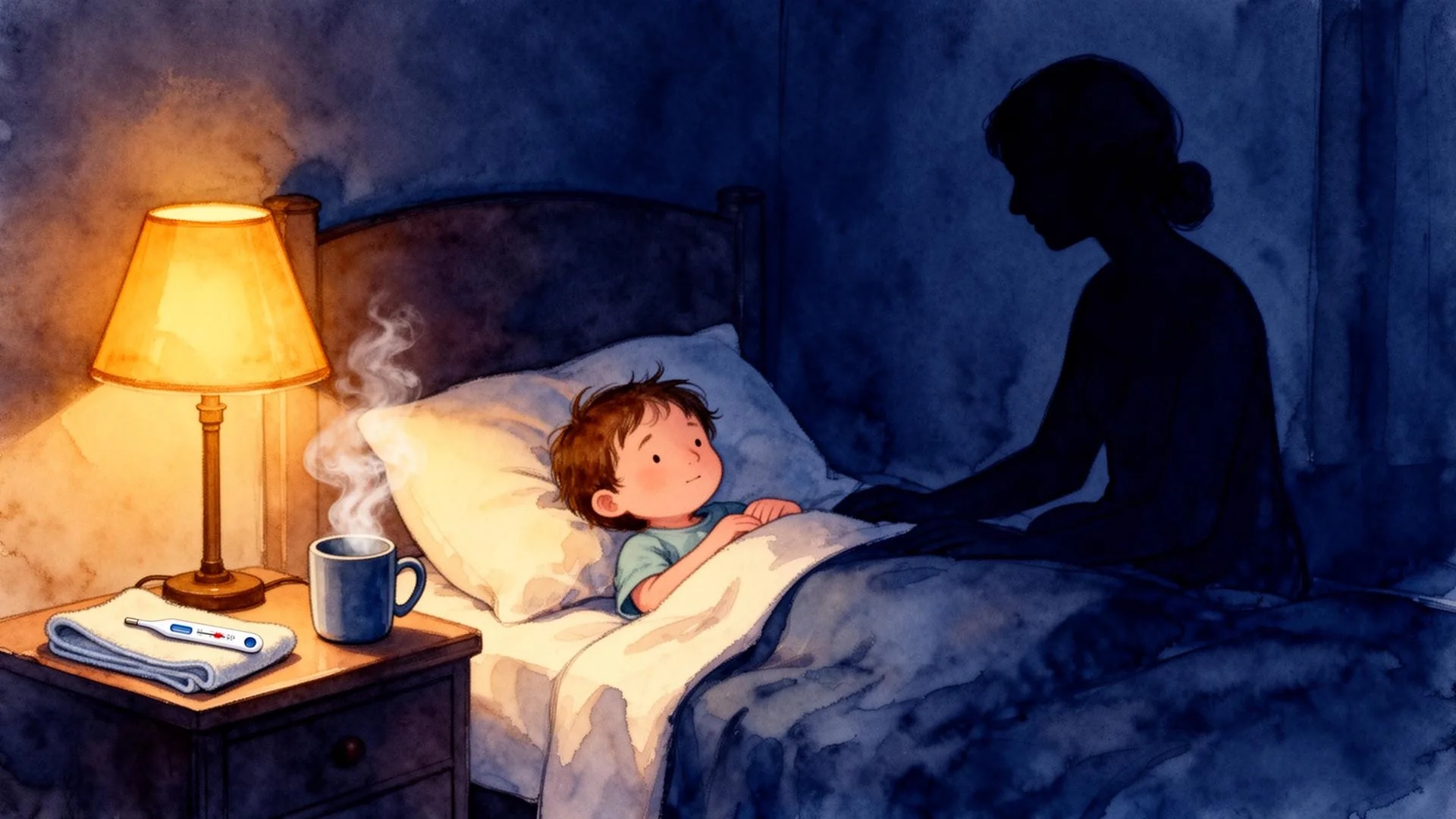
Your toddler is sick. They are uncomfortable, clingy, waking more than usual, and not settling the way they normally would.
The question most parents face in this moment is not «what is wrong with my child» — they know what is wrong. The question is what to do with the routine.
Do you hold the routine and risk adding distress to an already distressed child? Do you abandon it entirely and start from scratch once they're better? Do you stay in the room until they fall asleep, knowing that reintroducing the goodbye phrase next week will be a battle?
This post answers all three questions — and separates the illness phase (what to do while they are actually sick) from the recovery phase (the 3-night re-entry that gets the routine back without starting from scratch).
Why illness disrupts toddler sleep
Understanding the mechanism makes the response clearer.
Fever and temperature dysregulation
Sleep architecture depends on the core body temperature cycle. As the body prepares for sleep, core temperature drops — this drop is part of the signal that allows melatonin to rise and deep sleep to begin.
Fever disrupts this cycle. A child with a fever cannot produce the normal temperature drop that precedes sleep onset. They may fall asleep from exhaustion but the sleep is lighter, more fragmented, and less restorative than normal. Night wakings during fever are physiological — not behavioural, not a regression, not a developing sleep association. They are the fever.
If this sounds familiar, our guide Why your child keeps waking at night — and what to do about it goes deeper.
This distinction matters because the response is different. Behavioural night wakings require consistency and non-reinforcement. Physiological night wakings during fever require comfort.
Nasal congestion and breathing disruption
Toddlers are obligate nasal breathers — they breathe primarily through the nose during sleep. Nasal congestion from a cold or upper respiratory infection disrupts the breathing pattern, causes more frequent partial arousals, and reduces the depth of sleep stages. A congested toddler wakes more frequently not because of a sleep association but because breathing is physically harder.
Physical discomfort and pain
Ear infections, throat pain, teething-adjacent inflammation, and generalised body aches all produce the same effect: the child reaches a light sleep stage, experiences discomfort, and wakes fully rather than cycling back into deeper sleep as they would when well.
The comfort association risk
Here is where the illness phase and the routine phase intersect. During illness, most parents respond to night wakings with more contact, more presence, and more comfort than they would during a normal night — and rightly so. The risk is that a pattern established during 5–7 days of illness (parent in the room, feeding to sleep, lying down next to the child) becomes the expectation on night 1 of recovery, when the illness is resolved but the child still expects the illness-response.
This is the most common cause of post-illness sleep disruption: not the illness itself, but the comfort patterns installed during it.
The illness is not the sleep problem. The illness is the disruption. The sleep problem comes after — when the fever has cleared, the child is biologically well, but the 7 nights of parental presence at 2am has installed a new expectation that the child will now enforce. The 3-night re-entry is how you dissolve that expectation without a week of battles.
Phase 1 — During the illness: what to hold, what to let go
The key principle during illness is proportionality: hold what costs nothing to hold, let go of what creates genuine distress in an already distressed child.
What to hold during illness
The physical structure of the routine. Bath, pyjamas, teeth, books, goodbye phrase — abbreviated if necessary, but in the same sequence and the same location. A sick child's nervous system responds to familiarity more than a well child's. The routine is comfort as much as it is sleep preparation.
The sleep location. This is the most important thing to hold during illness. If the child normally sleeps in their own bed, keep them in their own bed during illness — even if it means you are sleeping on the floor beside them, or checking in more frequently. Moving the child to the parental bed during illness creates a comfort association with co-sleeping that is very difficult to dissolve once recovery begins.
The goodbye phrase. Use it every time you leave the room during illness — including the check-in visits during the night. Consistency of the phrase maintains its function as a closing signal even across a disrupted week.
What to let go during illness
The timing. A sick child who needs to sleep at 17:30 should sleep at 17:30. A sick child who cannot settle until 21:00 because of fever should not be held to a 19:00 bedtime. Let the illness determine the timing. Protect the sequence, not the clock.
The response time. During fever, respond to wakings promptly. The distinction between behavioural and physiological waking applies here: a child waking from genuine physical discomfort should be responded to. Save the 2-minute wait for nights when the illness has clearly resolved.
The length of the settling. If the child needs 30 minutes of presence to settle during a high-fever night, give it. This is not setting a precedent — it is responding to a physiological need. The re-entry method addresses the reset once recovery begins.
One nap rule exception. If a child who dropped the nap is exhausted during illness and falls asleep, let them. One or two illness naps do not restart the nap-dropping process. The body prioritises recovery sleep.
Phase 2 — The 3-night re-entry after illness
Once the fever has been gone for 24 hours and the child is eating and playing normally, the illness phase is over. The re-entry phase begins.
The goal of the re-entry is to dissolve the comfort patterns installed during illness — without a cold-turkey reset that creates a week of battles.
Re-entry Night 1 — Full routine, extended presence
Run the full routine in the correct sequence at the correct time. Do not abbreviate it — the full sequence re-establishes the settling signal.
At lights out: instead of leaving immediately after the goodbye phrase, stay in the room for 5 minutes after the child is lying down. Sit on a chair or at the edge of the room. You are present but not actively settling.
If the child calls out during the night: respond after 2 minutes (not immediately as during illness). Use the goodbye phrase. Exit.
This night is a bridge between the illness response and the normal response. The presence is deliberate and time-limited — not open-ended as it was during illness.
Re-entry Night 2 — Routine plus brief presence
Full routine. Goodbye phrase. Leave the room after the phrase.
If the child calls out within 5 minutes: return once, sit briefly outside the door or just inside the doorway, give the phrase, leave. Do not re-enter a second time unless the distress is clearly genuine and intense.
Night 2 will typically produce more resistance than night 1 — the extended presence on night 1 set an expectation. This is expected and normal. Hold the response.
Re-entry Night 3 — Back to normal
Full routine. Goodbye phrase. Leave. Normal response to wakings.
By night 3, the 7-night illness pattern has been replaced by a 2-night bridge pattern. Most children settle with minimal resistance on night 3 because the re-entry was gradual enough not to produce the full extinction burst that a cold-turkey reset would create.
If night 3 still involves significant resistance: hold the normal response for 2 more nights. Do not extend the bridge. The resistance on night 3–4 is the extinction burst — it will resolve on night 4 or 5.
The specific situations
The child who was settled in the parental bed during illness
If the child spent several nights in the parental bed during illness, the re-entry looks slightly different:
- Night 1: Move back to the child's own bed. Run the full routine. Stay in the room for 10–15 minutes after lights out, sitting beside the bed (not in the bed). This reintroduces the sleep location before reducing presence.
- Night 2: Routine, goodbye phrase, sit in a chair in the room (not beside the bed) for 5 minutes after lights out.
- Night 3: Routine, goodbye phrase, leave. Normal response to wakings.
The parental bed re-entry takes one extra night compared to the standard re-entry because the location change is an additional adjustment on top of the presence reduction.
The child who was being fed to sleep during illness
If the child was nursed or bottle-fed to sleep during illness to manage discomfort:
- Night 1: Feed before the routine (at the bath stage), not at the end of it. This breaks the feed-to-sleep sequence while keeping the feed itself. After the routine, use presence to settle rather than feeding.
- Night 2: Same structure. Feed is now fully separate from settling.
- Night 3: Standard routine, goodbye phrase, leave.
The key move is repositioning the feed earlier in the sequence rather than removing it — this is less disruptive for both parent and child and achieves the same result.
The child whose nap reappeared during illness
Many children who had dropped the nap will nap during illness. This is the body prioritising recovery sleep and should be allowed. Once recovery is clear:
- Day 1 post-illness: Offer quiet time but not a full nap. If the child falls asleep, allow up to 45 minutes and wake them before 14:30.
- Day 2 post-illness: Return to the pre-illness nap structure (quiet time for children who had dropped the nap; short nap for children still napping).
Do not allow illness napping to restart the nap-dropping process. One week of illness naps does not mean the child needs the nap again.
Preventing the worst outcome
The worst post-illness sleep outcome — a child who has essentially regressed 3–6 months in sleep independence — almost always involves two things:
- The child was moved to the parental bed during illness and remained there after recovery without a re-entry plan.
- The parent interpreted the post-illness resistance (which is the normal re-entry extinction burst) as evidence that the child was still sick and extended the illness response accordingly — creating a longer and more entrenched comfort pattern.
Both are understandable. Neither is easy to avoid in the moment. Knowing that post-illness resistance is normal and expected — not a sign of relapse or ongoing illness — is the most useful preparation for the re-entry nights.
When to seek medical advice
Sleep disruption during and after illness is almost always a normal consequence of the physiological effects described above. However, seek medical advice if:
- The child has had a fever for more than 48 hours and it is not responding to age-appropriate fever management.
- The child's breathing during sleep sounds laboured, includes long pauses, or involves visible effort in the chest or abdomen.
- The child is significantly harder to rouse than usual during sleep, or cannot be fully awakened during a night waking.
- The child has had an ear infection and is waking with ear pain in a specific, consistent pattern — this may indicate the infection has not fully resolved.
These are medical questions, not sleep questions. Resolve the medical issue before addressing the sleep pattern.
What to do tonight
If your child is currently sick:
- Run the abbreviated routine in the usual location.
- Keep the sleep location the child's own bed if at all possible.
- Use the goodbye phrase every time you leave the room.
- Respond promptly to distress during high fever. Apply the 2-minute response once fever resolves.
- Note the comfort patterns you are using — presence, feeding, location — so you know what the re-entry will need to address.
If your child recovered from illness in the last 1–3 days: begin the 3-night re-entry tonight. Night 1 extended presence, night 2 brief presence, night 3 normal. Hold the full routine sequence throughout. Expect resistance on night 2 — it is the bridge working as intended.
More on these topics
Related sleep guides
Want someone to look at this with you tonight?
Nora Live is a 25-minute voice consultation, available right now — no waiting list. You get the session report, your 5-night plan and five nights of chat follow-up. $89.
$45 one-time · No account, no app