SAFE SLEEP
My baby rolls onto their tummy and wakes up screaming. What do I do?
Your baby learned to roll but can't roll back, so they get stuck on their tummy and scream at 2am. What's normal, what's safe, and how to get through the rolling phase.
In this article
It's two in the morning and the monitor erupts. You run in and find your baby face-down, arms pinned, furious, unable to get back. You flip them over, settle them, tiptoe out. Twenty minutes later, it happens again.
The AAP safe-sleep guidance and the US Safe to Sleep campaign both say to begin every sleep on the back and keep the sleep space firm, flat and clear.
If this is your night, you're in one of the most common and most exhausting phases of the first year. It is also, in almost every case, short. Here is what's happening, what's safe, and how to get through it with as little lost sleep as possible.
Why this happens now
Most babies learn to roll from back to tummy somewhere between four and six months. Rolling back again, from tummy to back, often comes a few weeks later. That gap is the problem. For a while, your baby has a skill they can start but can't finish.
And babies practise new skills relentlessly, including in their sleep. During light sleep, the brain rehearses what it has been learning during the day. So a baby who has just discovered rolling will often roll in their sleep, half-wake on their tummy in an unfamiliar position, and get upset because they can't get out of it.
It's the same developmental burst that drives a lot of the disrupted sleep around this age. If your baby also seems more wakeful, distractible at feeds and harder to settle generally, read what's actually happening in the 4-month sleep change. Rolling often arrives alongside it.
Is it safe for my baby to sleep on their tummy?
This is the question underneath the screaming, so let's answer it clearly.
Always put your baby down on their back to sleep, for every sleep, day and night, until their first birthday. That rule doesn't change when they learn to roll.
What changes is what you do once they've rolled. Health guidance, including from the American Academy of Pediatrics, says that once a baby can roll both ways on their own, from back to tummy and from tummy to back, you don't need to turn them back if they roll during sleep. A baby with both skills can move themselves out of an uncomfortable position.
If your baby can roll only one way, you can gently return them to their back when you notice. You do not need to stay awake watching the cot. Keep placing them down on their back, keep the sleep space clear, and ask your paediatrician if they have difficulty lifting or turning their head.
Three things matter more than anything else during this phase:
- Stop swaddling. As soon as your baby shows any signs of trying to roll, swaddling needs to stop. A swaddled baby who rolls onto their tummy can't use their arms to lift their head or push back. If you're still swaddling, here's how to stop gently.
- Keep the cot completely clear. Firm, flat mattress, fitted sheet, nothing else. No pillows, bumpers, rolled towels or soft toys.
- Don't use positioners or wedges. Products that claim to keep a baby on their back are not recommended and can be dangerous.
If your baby seems to struggle to lift their head when on their tummy, or you have any concerns about their muscle tone or development, talk to your doctor or health visitor.
The fastest way through: more practice during the day
The single most effective thing you can do is help your baby learn the second half of the skill. The sooner they can roll from tummy to back, the sooner the 2am rescues stop.
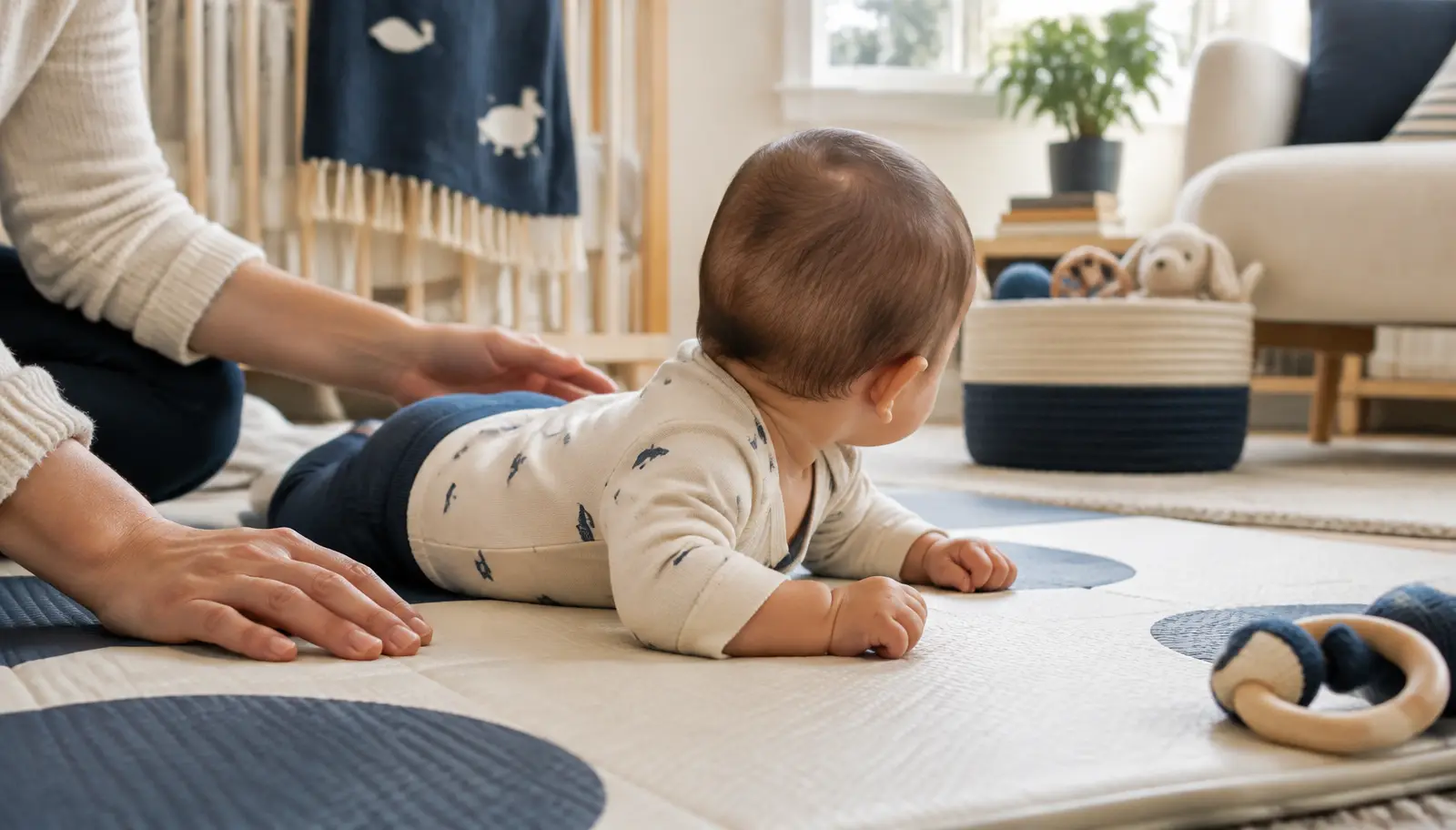
Give lots of floor time. Babies learn rolling on a firm, open surface. Several short sessions a day on a play mat do more than one long one.
Make tummy time purposeful. Once your baby is on their tummy, place a favourite toy slightly to one side and above their eye line. As they reach and look up and over, their weight shifts, and rolling to the back often follows.
Show them the movement. With your baby on their tummy, gently tuck one arm close to their body, then guide their hip and shoulder over in the same direction. Do it slowly and cheerfully. Practise both sides. Many babies only roll one way at first.
Celebrate it. Babies repeat what gets a big reaction. Make a fuss when they roll back.
The timing varies. Regular, supervised floor play supports practice, but it is not possible to promise when a baby will master rolling both ways.
What to do at night while you wait
Respond calmly and briefly. Go in, roll your baby onto their back, and settle them with as little stimulation as possible. Low light, soft voice, a hand on the chest. The goal is to make the rescue as boring as possible.
Try a short pause first, if your baby is just grumbling. Some babies fuss on their tummy for a minute and then settle there, or even roll back on their own. If your baby is not genuinely distressed and they can roll both ways, give them a moment before you go in. If they can't yet roll back, or they're truly upset, go in.
Don't go back to swaddling. It can be tempting at 3am, because the swaddle used to fix everything. It isn't safe once rolling has started.
Watch the timing of naps and bedtime. Overtired babies sleep more lightly and wake more easily from small disturbances. During a skill burst, many babies need a slightly earlier bedtime or shorter awake windows for a couple of weeks. The wake window calculator can help you check.
Use an arms-free sleeping bag. It keeps your baby warm without loose blankets and leaves their arms free to push up and roll.
When your baby sleeps happily on their tummy
Many parents are surprised by what happens next. Once babies can roll both ways, a lot of them start to prefer their tummy, and some sleep far better that way. That's fine. Keep putting them down on their back, and let them choose their position once they're moving freely.
A realistic timeline
- Week 1: Baby rolls to tummy at night and can't get back. Frequent wake-ups. You're doing a lot of rescues.
- Weeks 1–2: Daytime practice starts paying off. Baby can roll back sometimes, often only on one side.
- Weeks 2–3: Baby rolls both ways reliably. Night rescues become rare. Many babies settle into tummy sleeping.
Some babies move through this in a week. Some take a month. Either is normal.
When to talk to a doctor
Speak to your doctor or health visitor if:
- your baby seems unable to lift their head or chest when on their tummy;
- they seem floppy, or stiff, or use one side of their body much more than the other;
- they are rolling much earlier than expected and you're worried about safe sleep;
- the night waking continues for weeks after they can roll both ways.
The short version
Rolling and getting stuck is a temporary phase caused by a new skill your baby can start but not yet finish. Put your baby down on their back, stop swaddling, keep the cot clear, and return them to their back when you notice until they can roll both ways. Put your energy into daytime practice. That's what ends the 2am screaming fastest.
If the rolling phase has knocked your whole routine off track, a personalised plan built around your baby's age and schedule can help you get it back. And if you'd like to talk it through tonight, Nora Live is there.
Lunio provides educational sleep coaching, not medical diagnosis or treatment. Follow your child's clinician and local safe-sleep guidance.
More on these topics
Want someone to look at this with you tonight?
Nora Live is a 25-minute voice consultation, available right now — no waiting list. You get the session report, your 5-night plan and five nights of chat follow-up. $89.
$45 one-time · No account, no app