DEVELOPMENT
My baby stands up in the crib and can't get back down to sleep
Your baby pulls to stand in the cot, then cries because they can't get down. Why it happens around 8 to 10 months, how to teach them to sit back down, and what to do at night.

In this article
You put your baby down drowsy and content. Thirty seconds later, they're up. Standing, gripping the rail, swaying, delighted. Then not so delighted. They're exhausted, they want to lie down, and they have absolutely no idea how. So they cry. You lay them down. They pop straight back up. Repeat until midnight.
Follow your crib manufacturer's height and milestone limits. The US Consumer Product Safety Commission crib guidance also emphasizes a firm, flat, bare sleep space.
If this is your evening, welcome to one of the most predictable and most maddening phases of the first year. It's short, it's normal, and there's a lot you can do to speed it along.
Why this happens
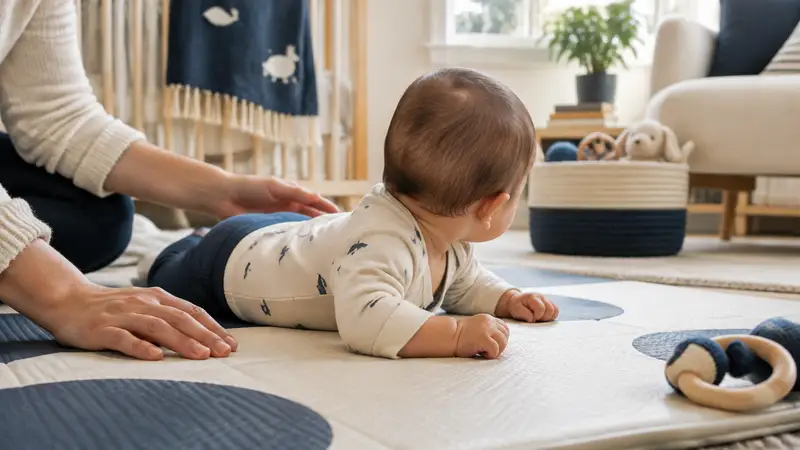
Somewhere between about eight and ten months, many babies learn to pull themselves up to stand. It's an enormous milestone. But like rolling a few months earlier, babies often learn the first half of a skill before the second. Pulling up is easy. Getting down again, by bending the knees and lowering safely, takes more strength, balance and confidence.
So for a few weeks, your baby can get up but can't get down. And because their brain is busy practising this exciting new skill, they do it all the time, including at bedtime, in the middle of the night, and at 5am.
There's also a bigger picture. This milestone often arrives at the same time as separation anxiety, crawling and big leaps in language understanding. All of that can make sleep worse for a while. If it feels like everything has fallen apart at once, read why is 10-month sleep suddenly so much worse.
Step one: lower the mattress
Before anything else, make sure the cot mattress is on its lowest setting. Once a baby can pull to stand, a higher mattress means a lower rail relative to their body, which raises the risk of a fall. Most cots have several heights. Move it down now, even if you planned to wait.
Also remove anything your baby could stand on or use to climb, like large soft toys or cot bumpers (which shouldn't be in the cot anyway).
Step two: teach the skill during the day
The fastest way out of this phase is to help your baby master getting down. Practise several times a day, when they're rested and happy, not at bedtime.
Practise at a low surface. Let your baby pull up at the sofa or a low table. When they're standing, place a toy on the floor and encourage them to reach for it. To get it, they'll need to bend their knees.
Guide the movement. Gently place your hand behind their knees and help them bend, lowering their bottom to the floor. Say a simple word each time, like "sit down" or "down we go". Keep it light and playful.
Practise in the cot too. During the day, put your baby in the cot with a few toys and practise the same thing there. Bend their knees, guide them down, celebrate. This helps them learn that the cot is a place where they can get down safely.
Make a big fuss. Clapping, cheering, a happy face. Babies repeat what gets a reaction.
With supervised daytime practice, many babies become more confident lowering themselves, but the timeline varies.
Step three: what to do at bedtime and at night
Do one gentle lay-down, then let them work on it. If your baby stands up at bedtime, it's fine to go in once or twice, guide them back down, and repeat your calm goodnight phrase. But if you lay them down every time they stand, many babies treat it as a game. Every lay-down becomes an invitation to stand back up.
Stay close instead of laying them down repeatedly. After a couple of attempts, try sitting nearby. Offer calm reassurance. Pat the mattress. Say "lie down" in a quiet, boring voice. Most babies, once tired enough, will eventually sit or flop down on their own.
Let them fall asleep however they land. Some babies collapse in a heap and fall asleep sitting up, or curled up on their knees, or with their bottom in the air. That's fine. Once they're asleep, they'll usually shift into a comfortable position. You don't need to reposition them.
Keep night wake-ups brief and dull. At 2am, if your baby is standing and crying, go in, help them down once with minimal interaction, say your phrase, and leave or sit nearby. Avoid turning it into play time.
Check the timing. An overtired baby is far more likely to stand and fight sleep. During this phase, many babies benefit from a slightly earlier bedtime or a slightly shorter last awake window. The wake window calculator can help you check.
Use an arms-free sleeping bag. It doesn't stop standing, but it can make it a little harder, and slows babies down. Make sure it's the right size, so the neck opening is snug.
What not to do
Don't put anything in the cot to stop them standing. Wedges, rolled blankets, straps or positioners are not safe.
Don't use crib tents or covers. These have been linked to injuries and aren't recommended.
Don't panic about the crying. Your baby isn't hurt or trapped. They're frustrated. Your calm presence and daytime practice are what help.
How long will this last?
For most babies, the standing-up phase lasts about one to three weeks. Once they can confidently get down, the novelty fades and bedtime goes back to normal. Some babies then start cruising along the cot rail for a while. That's another phase that passes.
If sleep is still very disrupted a month later, it's likely something else is going on too, such as a nap transition, separation anxiety, or a sleep association that's become harder to sustain. See regression or habit for how to tell the difference.
When to talk to a doctor
Speak to your doctor or health visitor if your baby seems to have difficulty bearing weight on one or both legs, consistently uses one side of their body more than the other, or if you have any concerns about their movement or development.
The short version
Pulling to stand without knowing how to sit back down is a short, normal phase around eight to ten months. Lower the mattress, practise sitting down from standing during the day, and at bedtime, guide your baby down once or twice, then stay close and let them work it out. Within a couple of weeks, most babies master it, and sleep returns.
If this phase has knocked your routine off course, a personalised plan built around your baby's age can help you get it back.
Lunio provides educational sleep coaching, not medical diagnosis or treatment. Follow your child's clinician and local safe-sleep guidance.
More on these topics
Want someone to look at this with you tonight?
Nora Live is a 25-minute voice consultation, available right now — no waiting list. You get the session report, your 5-night plan and five nights of chat follow-up. $89.
$45 one-time · No account, no app